4 Futures Trading Education Topics to Build Your Foundation
There’s no fixed timetable for learning futures trading; your pace depends on how steadily you study the mechanics, practice decisions, and review risk. Strong futures trading education starts with the contract itself, since tick increments, expiration dates, and position risk shape each trade; study fundamentals and practice in a simulated environment before considering live trading.
This guide explains how contract differences shape the learning curve, where to begin, and how free lessons can help you build a disciplined foundation, prepare your decisions, and connect market analysis with planned risk.
Key Takeaways
- Build your learning pace around studying contract mechanics, practicing decisions, and reviewing risk before trading live.
- Compare contract size, tick increments, and expiration dates to understand how each contract can affect a trade.
- Look for guidance that explains diversification, speculation, and hedging while connecting market decisions to a planned risk process.
- Use free lessons to strengthen your foundation and connect each market decision to a planned risk process.
How long does futures trading education take?
There’s no fixed timetable for learning futures trading. Your pace depends on building market knowledge, practicing analysis, and applying risk controls consistently. Start with one market, such as gold futures, and study its contract terms and price behavior before adding another. A planned progression matters more than rushing into live trades.
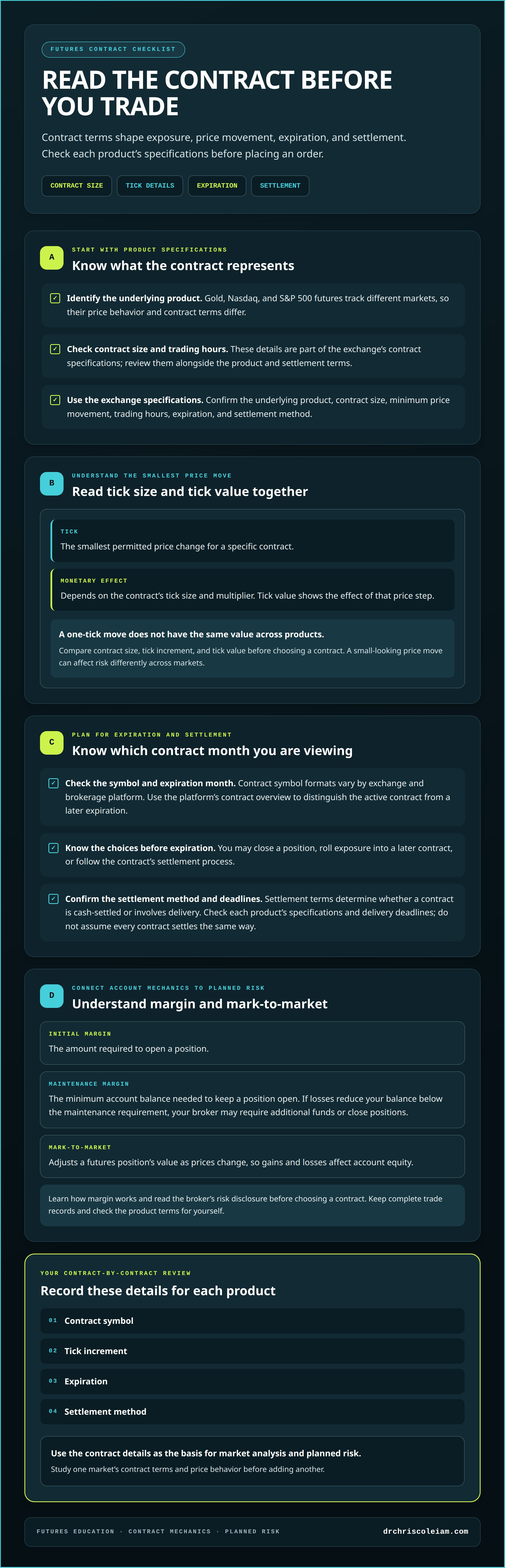
Understand margin before placing a futures trade. Initial margin is the amount required to open a position; maintenance margin is the minimum account balance needed to keep it open. If losses reduce your balance below the maintenance requirement, your broker may require additional funds or close positions. Mark-to-market accounting adjusts a futures position’s value as prices change, so gains and losses affect account equity. Read the broker’s risk disclosure and learn how margin works before choosing a contract.
Futures are standardized contracts tied to an underlying market, while stocks represent ownership in a company. Options give the holder a right, but not an obligation, under the contract terms; ETFs hold a basket of assets or track an index. Futures and options can both have expiration dates, but their rights and obligations differ. No structure guarantees protection from loss.
Keep protection rules in the right context. According to the U.S. Securities and Exchange Commission, SIPC protects eligible securities customers of its members up to $500,000, including up to $250,000 for cash claims; this protection concerns eligible securities customers, not a promise about futures trading accounts.
A trading educator can help you assess markets by explaining contract mechanics, schedule considerations, and risks to plan for. Study how economic events, such as Federal Reserve announcements, can affect market movements, then compare that context with a trading demonstration or market analysis. Treat news as context, not a signal, and review each example’s entry, risk plan, and exit logic. This builds knowledge without mistaking a demonstration for a personal trading plan.
2. Contract differences, tick increments, and expiration dates
Start with the contract specifications published by the exchange where a futures contract trades. These basics identify the underlying product, contract size, minimum price movement, trading hours, expiration, and settlement method. For example, Gold, Nasdaq, and S&P 500 futures track different markets, so their price behavior and contract terms differ. Traders need those details before placing an order through a brokerage account.
A tick is the smallest permitted price change for a specific contract. Its monetary effect depends on the contract’s tick size and multiplier, so a one-tick move does not have the same value across products. Read the specifications together: contract size explains exposure, tick increment measures the smallest price step, and tick value shows its effect. Compare these details before selecting a contract; a small-looking price move can affect risk differently across markets.
Contract symbols help traders identify a product and its expiration month. The exact format varies by exchange and brokerage platform, so use the platform’s contract overview to distinguish the active contract from a later expiration. Futures contracts expire. Before expiration, traders may close a position, roll exposure into a later contract, or follow the contract’s settlement process. Settlement terms determine whether the contract is cash-settled or involves delivery. Check each product’s specifications and delivery deadlines rather than assuming every contract settles the same way.
In the United States, futures trading follows federal oversight and exchange rules, while tax treatment depends on the contract and your circumstances. Review relevant disclosures and keep complete trade records; a tax professional can explain how applicable rules affect your situation. For each product, record its symbol, tick increment, expiration, and settlement method. This contract-by-contract review gives your market analysis a firm basis and helps align decisions with planned risk.
Where should I look for guidance as a new futures trader?
Choose an educator who explains why a trade exists, not just where to enter. Strong instruction distinguishes speculation, hedging, and diversification. Speculation seeks returns from price changes; hedging uses futures to offset price exposure elsewhere. Diversification spreads exposure, but several contracts can still respond to the same market forces. Exchange education materials can help explain listed products, while an educator should connect each example to a strategy and risk plan. Ask how the lesson defines its setup, invalidation point, and exit.
Platform training should explain the order tools you’ll actually use. Chart Trader supports order entry from a price chart; SuperDOM displays prices and orders in a depth-of-market ladder. ATM strategies, on platforms that offer them, apply predefined trade-management settings. Learn how each tool handles entries, stops, and targets before using it in a live market. A demonstration should show the order sequence and explain what happens if price moves against the plan. Platform names and features vary, so match the lesson to your own interface.
Evaluate futures videos, articles, and courses by how they teach. Look for clear explanations of contract selection, market context, entry logic, risk, and review. A video showing a Nasdaq futures entry should also explain the conditions behind it and what would invalidate the idea. Useful instruction distinguishes recorded examples from live decisions and does not present one trade as proof of a lasting advantage. Review the instructor’s background and the course disclosure, including what the material covers.
Be skeptical of secret strategies and shortcuts. A trading method still needs defined conditions, planned risk, and a way to assess decisions across changing markets. Before trading futures based on a claim, identify the supporting evidence and what could make the idea fail. Clear education makes its assumptions visible. It doesn’t rely on urgency, hidden rules, or promises of results.
What to expect from free futures trading education
Free lessons can provide a useful starting point, especially when they teach futures fundamentals before discussing trade setups. Use each lesson to build one skill: identify a contract, explain its price movement, or describe the risk in a sample trade. Then note what the lesson leaves unanswered. A short class on order types, for example, may not teach market selection or execution discipline.
Judge the material by what you can explain afterward. Can you describe why a futures contract moves, how an economic announcement could affect its market, and what would invalidate a trade idea? Strong financial education connects these factors instead of presenting chart patterns alone. Revisit a lesson and summarize its main decision points in your own words. If an example omits its risk plan, treat it as incomplete instruction, not a ready-to-follow strategy.
Look closely at the purpose of a free seminar. An introductory event may promote advanced training, additional features, or investment opportunities. Separate teaching from promotion by noting how much time covers fundamentals and how much encourages enrollment. Urgency is not evidence that a course will improve your skills.
Before continuing, compare the free material with your learning needs. If a futures overview explains contract mechanics but skips planned risk, note that gap. If a video shows an entry without explaining market context, don’t treat the execution as a complete lesson. Compare course descriptions, instructor background, and curriculum before enrolling. Free education works best as a filter: it helps you identify what you understand, what you still need to learn, and whether a course explains that clearly.
Dr. Chris Cole IAM: Dr. Cole’s TradingView Algos
Dr. Chris Cole IAM offers Dr. Cole’s TradingView Algos to support traders’ market analysis. These tools are most relevant when you already have a defined approach and want to study how algorithmic indicators relate to your trading decisions. Use them as part of preparation, not as a substitute for understanding contracts, planned risk, or execution.
Futures and Options Trading Education can support your understanding of the markets and products you trade. Daily Auric Levels cover Gold, Nasdaq, and S&P 500 futures, while Auric Options Levels cover GLD, QQQ, and SPY. Connect any tool or level to your own market plan and review process.
If you’re ready to explore educational support and trading tools, contact Dr. Chris Cole IAM.
Build a Process You Can Review
Futures trading education becomes more useful when learning turns into a repeatable review habit. Decide what you’ll study, what would change your market view, and how you’ll record each decision. A clear process gives you something concrete to assess and refine as your knowledge grows.
Dr. Chris Cole IAM’s 4 Hr Trade Room community supports ongoing learning. Traders can use Daily Auric Levels for Gold, Nasdaq and S&P 500 Futures alongside Auric Options Levels for GLD, QQQ and SPY. Treat market references as part of your own analysis, not as a substitute for judgment.
When you’re ready to explore an approach that supports your continued development, contact Dr. Chris Cole IAM. Keep learning, keep reviewing your decisions, and build your next step with discipline.
Frequently Asked Questions
How long does it take to learn futures trading?
Learning futures trading takes ongoing study and practice, not a fixed number of days. A useful measure of progress is whether you can explain your trade thesis, identify what would invalidate it, and review whether you followed your plan. Keep a journal of the market context and your decisions. This turns each session into feedback for your next learning step.
Where should I start as a new futures trader?
Start with one market and one educational resource that explains its mechanics in plain language. Build a glossary of unfamiliar terms, then work through an example trade from idea to exit. The goal is to understand the reasoning, not copy an entry. Futures and options trading education is for general educational and informational purposes only, not individualized financial or investment advice. Markets and trading involve substantial risk, and you are solely responsible for your decisions, research, risk management, and actions.
What is futures trading and how does it work?
Futures trading involves buying or selling standardized contracts tied to an underlying product or financial index. A trader can take a long position when expecting a price rise, or a short position when expecting a decline. For example, a trader might use an S&P 500 futures contract to express a view on the index. Price changes affect the position, so plan risk before entering.
How do futures contracts, expiration dates, and contract specifications work?
A futures contract’s specifications define the product it tracks and the terms for trading and settlement. The contract symbol helps distinguish products and expirations on a trading platform. For instance, GC identifies Gold futures, while NQ identifies Nasdaq futures. As expiration approaches, traders decide whether to close a position, roll exposure into another contract, or follow the stated settlement process.
What are futures margin requirements and how do brokers set them?
Margin is collateral required to hold a futures position, and the amount can differ by contract and broker. Exchanges set minimum performance-bond levels, while a broker may require more based on its policies and market conditions. Understand how initial and maintenance requirements apply to the specific contract, and what happens if account equity falls below the required level. Plan for possible changes.