4 Ways to Size NQ Positions and Stay Calm in Volatility
The practical way to learn how to handle NQ futures volatility without panicking is to set a dollar risk limit, define your stop before entry, and size the position from the distance to that stop.
You’ll also see why NQ can demand a different position size than ES, how to scale exposure down as volatility rises, and which conditions to review before trading, including volatility readings, the expected range, and scheduled market events. That preparation gives you a repeatable decision process before price pressure tests your discipline.
Key Takeaways
- Set your risk limit and stop before entering, then choose a position size that fits both.
- Compare NQ’s faster swings with ES before applying the same trading plan to both markets.
- When volatility rises, reduce exposure or stand aside rather than stretching your risk limits.
- Build a pre-market routine around volatility readings, expected range, and scheduled events.
1. How Should You Configure Position Sizing for NQ?
Set your maximum dollar risk before choosing an NQ contract. Divide that limit by your stop distance in points, then by the contract’s point value. If the potential loss exceeds your planned risk, reduce your exposure or skip the trade.
That smaller dollar exposure lets you adjust directional risk in finer increments.
To size a position around your account risk, first choose the dollar loss your plan allows. Set a stop where the trade idea is invalidated, not where a small price wiggle feels uncomfortable. Divide your allowed loss by the stop distance and point value, then round down to a whole contract. If even one NQ contract exceeds your limit, consider MNQ or stay flat.
Plan around scheduled mega-cap earnings. Major company earnings can increase NQ volatility, so consider reducing your position size or avoiding the trade around the release. Before that event, calculate the potential loss at your stop and consider cutting size or avoiding the trade. A broker’s margin requirement does not define your risk limit.
Place the stop before entry and include overnight gap risk in your decision. NQ trades nearly 24 hours, but overnight spreads are typically 0.50-1.00 points, compared with 0.25 points during regular trading hours. A stop cannot prevent a gap from producing a different exit price. To avoid panic during swings, pause, plant your feet, take a slow exhale, and reread your written risk limit before acting.
2. NQ volatility compared with ES
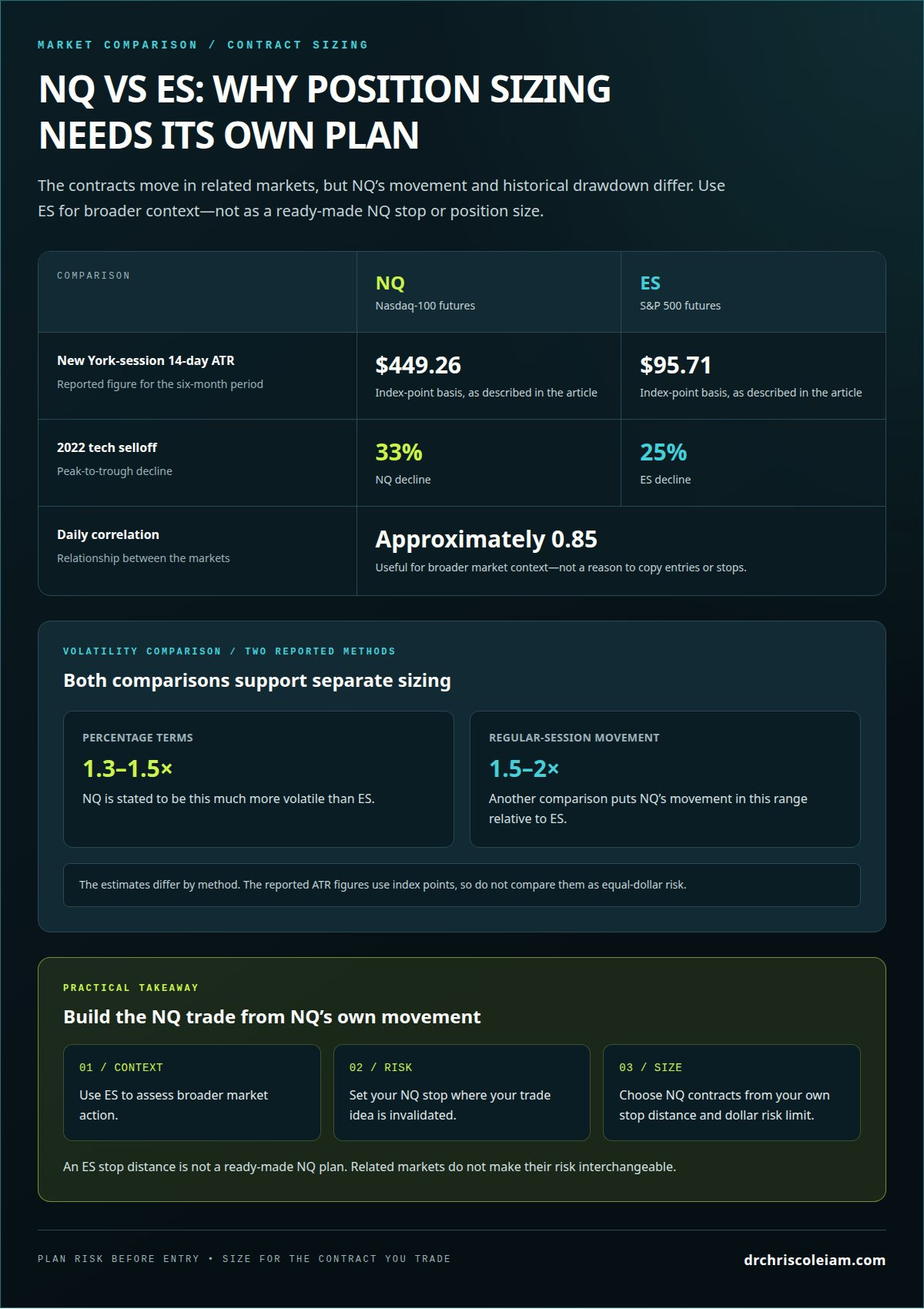
Treat NQ and ES as related markets, not interchangeable contracts. Over the reported six-month period, New York-session 14-day ATR measured $449.26 for NQ. ES measured $95.71, showing a wider point range in NQ. Those figures use index points, so don’t compare them as equal-dollar risk. In percentage terms, NQ is stated to be 1.3-1.5 times more volatile. Another comparison puts its regular-session movement at 1.5-2 times ES. The estimates differ by method, but both support separate sizing.
NQ and ES have a daily correlation of approximately 0.85. That relationship gives traders broader market context, not a reason to copy each other’s entries. During the 2022 tech selloff, NQ fell 33% peak-to-trough, while ES fell 25%. The larger decline shows how concentrated exposure to growth stocks can affect NQ. Use ES to assess broader action, then base your NQ contract decision on NQ’s own movement. Don’t treat an ES stop distance as a ready-made NQ plan.
Options and single stock futures also respond differently to market action. A standard single stock futures contract represents 100 shares of its underlying stock. A single stock future has no option premium or implied-volatility component. Options, by contrast, can respond to changes in implied volatility as well as the underlying price. Account for that difference when comparing directional exposure; the products don’t express risk in the same way.
NQ futures halt and price-limit handling follows the applicable futures contract exchange rules. Don’t assume that a trading halt for an individual Nasdaq-listed stock automatically determines what happens to NQ. Before taking action, identify the NQ contract procedures that apply to your trading session, then include possible pauses in your event plan. For a structured market reference, review Nasdaq futures levels alongside your own rules.
3. Reducing position size when volatility rises
Use volatility as a signal to cut exposure, not abandon your risk rules. When VXN rises above 30, consider MNQ instead of NQ. Both contracts follow the Nasdaq-100, so the market’s point movement is not smaller in MNQ. Its contract size is one-tenth of NQ, giving you finer control over dollar exposure. Reduce contract count as swings expand, and keep your stop tied to the trade idea.
Economic releases can change NQ’s pace within a short window. Around FOMC announcements at 2:00 PM ET, NQ has moved 80-150 points within 15 minutes. Before a high-impact release, choose whether your plan allows a smaller position or requires staying flat. Don’t enter a breakout simply because the opening range is moving quickly. A planned target and loss limit should guide your action, not urgency.
Margin affects how many contracts your account can carry, but it does not determine your acceptable loss. Margin figures describe the amount required to hold a position, not the amount you risk on a trade. Check the margin requirement for your account, then size your position based on your stop distance and risk limit.
Before entry, calculate the risk at your planned stop. If volatility requires a wider stop, fewer contracts may keep your dollar risk within its limit. If one NQ contract still exceeds that limit, MNQ allows smaller increments. If MNQ also exceeds it, stand aside. During a fast Nasdaq session, record why you changed your size, such as an economic release or expanding price movement. After the session, review whether the decision followed your plan.
4. Pre-market volatility checks and trading workflow
A practical answer to how to handle NQ futures volatility without panicking begins before the opening bell. Start each futures trading session by checking VXN and VIX, reviewing scheduled economic releases, and noting overnight movement. VXN above 27 marks a level where NQ trading character shifts. Treat that reading as a reason to reassess exposure, setup quality, and position size, not as an entry signal.
Use volatility measures and the NQ price to frame a rough expectation for the day’s range, rather than treating it as a forecast. A VXN reading of 22 with NQ at 20,500 gives a one-standard-deviation expected range of 284 points. Use this estimate as context, not a price target or directional prediction. Compare it with the session’s developing range before deciding whether movement is extended.
Give the first 30-60 minutes of the New York session extra attention. NQ futures typically make their biggest moves then, as volume builds around the open. Define which setup qualifies, where the idea fails, and what keeps you out. A fast opening move alone doesn’t confirm a breakout.
On Non-Farm Payrolls days, pause NQ trading from 8:00 AM to 9:30 AM ET. Use that window to review the release schedule and avoid entering before your conditions are clear. If the opening move expands the range, reassess risk before considering a trade. A mini Nasdaq contract can reduce dollar exposure, but it can’t remove event risk or validate an unclear setup.
A repeatable way to handle NQ futures volatility without panicking is to record three pre-market decisions: your permitted setup, maximum exposure, and condition for standing aside. After the session, compare actual NQ moves with the expected range and note whether you followed your plan. This makes volatility checks part of your trading workflow rather than a reaction to every price swing.
Dr. Chris Cole IAM
Dr. Chris Cole IAM offers trading education and tools that can support a more structured approach to NQ volatility. Daily Auric Levels for Gold, Nasdaq and S&P 500 Futures provide key price levels to include in your market analysis, while Dr. Cole’s TradingView Algos and Auric Trading Assistant offer additional tools for your trading process. Use these resources alongside your own position-sizing rules, stop plan, and review of market conditions. They don’t replace your risk decisions.
Dr. Chris Cole IAM offers daily Nasdaq futures levels, TradingView tools, and education to support a disciplined futures routine. Use them as reference points while preparing: assess volatility, define your exposure, and follow your plan rather than reacting to each swing. To explore the education and tools, contact Dr. Chris Cole IAM.
Build a More Consistent Trading Process
Make your next step a repeatable review. Record what shaped your decision, whether your plan matched the market, and what you will refine before your next session. This turns handling NQ futures volatility without panicking into a practice strengthened through preparation and reflection, rather than a demand to predict every move.
Dr. Chris Cole IAM offers educational resources and mentorship, along with Daily Auric Levels for Gold, Nasdaq and S&P 500 Futures and Auric Options Levels for GLD, QQQ and SPY. These offerings can support your ongoing study while you remain responsible for your own trading decisions. Ready to continue building your process? Start a conversation with Dr. Chris Cole IAM. Keep learning, stay disciplined, and grow as a trader.
Frequently Asked Questions
How Should You Configure Position Sizing for NQ?
Set a maximum loss for the full session, then account for every open position that could respond to the same market move. Two trades on correlated indexes can create more combined risk than either trade suggests on its own. Before adding a position, calculate the combined planned loss at each stop. If it exceeds your session limit, skip the trade or reduce existing exposure.
What makes E-mini Nasdaq-100 (NQ) futures especially volatile?
NQ can cover far more ticks during the same interval as ES. One comparison shows NQ moving 40 ticks while ES moves 3 ticks. That difference matters when you use a familiar ES rhythm to judge NQ entries: price can travel through several decision points quickly. Track NQ’s own movement and avoid assuming that ES pace predicts how much time you have to act.
What stop-loss and risk limits can help manage NQ futures trades?
Use the five-minute ATR as a volatility reference, then fit the stop to your setup and risk plan. A normal five-minute NQ ATR(14) reading is 20-45 points; one recommendation places stops at 1.5-2 times ATR(14), typically 45-90 points. These figures describe a framework, not a universal stop. A stop should reflect where your trade idea fails.
How can traders create a pre-trade plan for volatile NQ sessions?
Write down what happens after your first planned entry: whether you can re-enter, what invalidates the setup, and when you will stop trading for the session. Test those rules in paper trading before risking capital. Track whether you followed the rules separately from the trade outcome. A losing trade can follow the plan, while a profitable one can still reveal a process error worth correcting.
How do economic releases and Federal Reserve announcements affect NQ futures volatility?
Releases can trigger abrupt repricing before you have time to adjust an order. NQ can move 100 points within seconds on a miss in the U.S. Nonfarm Payrolls release. Treat the scheduled release as a distinct risk condition in your plan. Decide beforehand whether you will remain flat through it or wait for a new setup after the initial reaction.
What are the risks of margin, margin calls, and overnight NQ futures positions?
Compare the contract’s notional exposure with the margin required to hold it. Margin requirements can differ by broker. Before holding overnight, understand the requirement for your account and how your broker handles a shortfall.