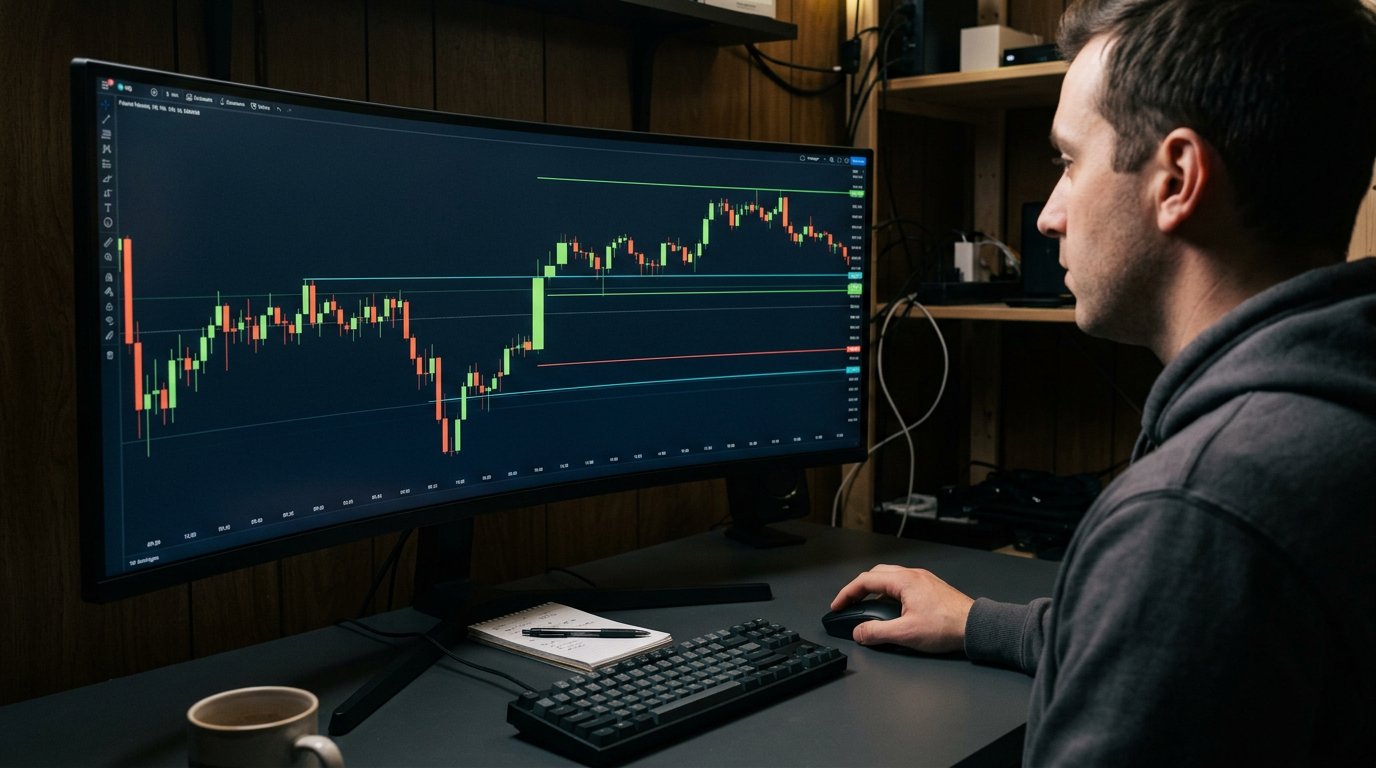
How to set entries and exits for an NQ opening range breakout
For an NQ opening range breakout strategy, define the range as the high and low of the first 30 minutes of regular trading, from 9:30 a.m. to 10:00 a.m. ET; traders also use shorter windows, so choose one duration and apply it consistently. A breakout entry can trigger when a 1-minute or 5-minute candle closes above the range high for a long trade or below the range low for a short trade, with stop and target rules set before entry.
That structure gives you a plan, but gaps can change where NQ opens relative to the prior session and the range. Account for that context instead of treating every break as the same setup. Learn to mark the range, define long and short triggers, plan exits, and build gap-aware rules into a disciplined process. No setup promises a profit.
Key Takeaways
- Choose a consistent range and use candle-close confirmation to help distinguish a breakout from a brief move beyond the boundary.
- Build separate long and short entry rules, then use a directional filter and a clear cutoff to avoid chasing late moves.
- Set your stop, target, and automation rules before entry; match stop placement to your risk plan and NQ’s movement.
- Account for overnight gaps by assessing where the open sits relative to your planned range and deciding in advance when to stand aside.
What is the opening range?
For NQ, define the opening range as the high and low formed after the U.S. equity session opens. The structure is similar to an ES opening range strategy, but NQ can move faster early in the session, so don’t copy another contract’s range or risk settings. NQ also carries volatility and slippage risk: fast price changes can result in an execution beyond its planned level.
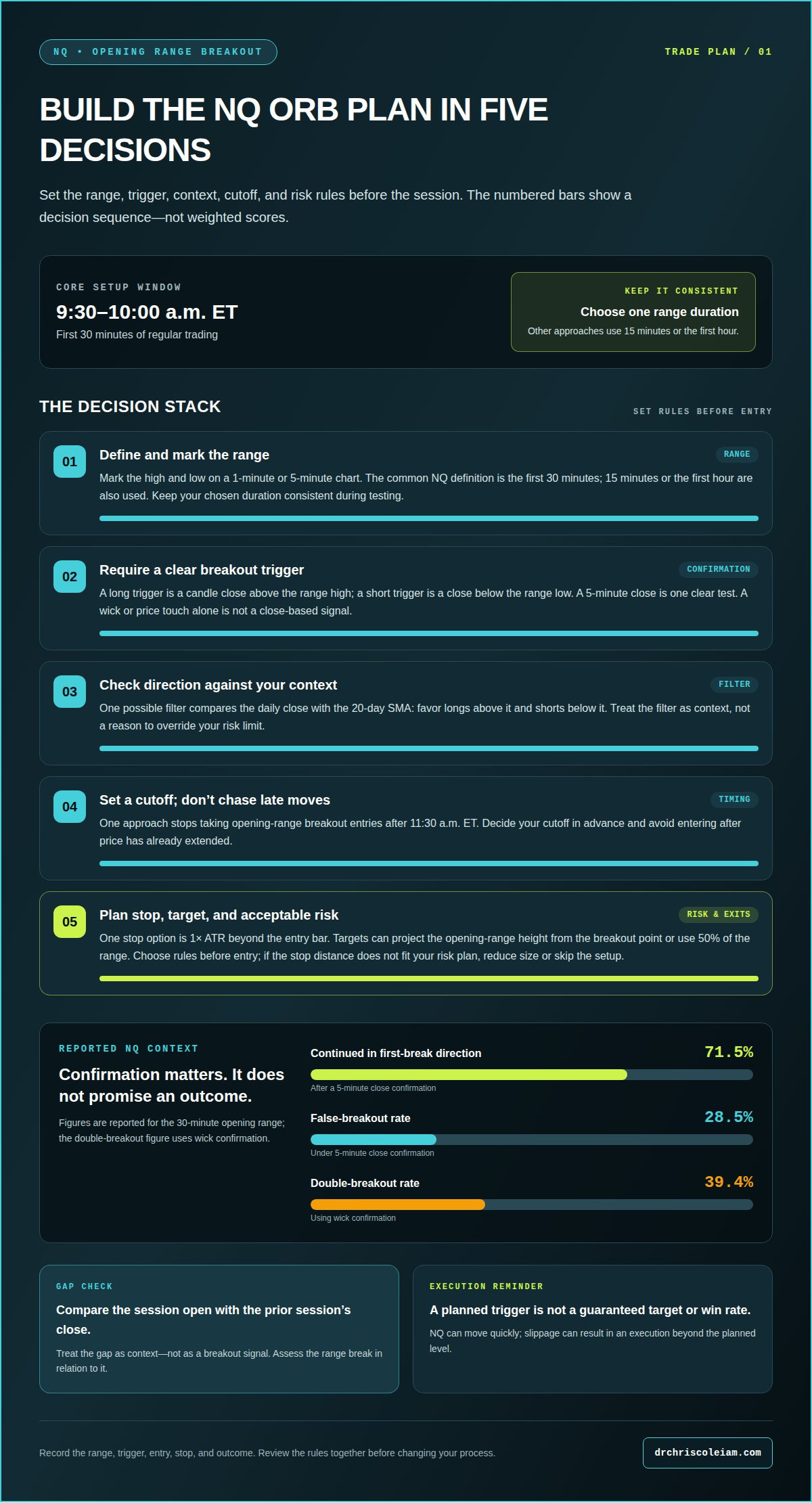
- Choose and mark one timeframe. A common NQ opening range uses the first 30 minutes, from 9:30 a.m. to 10:00 a.m. ET. Other approaches use 15 minutes or the first hour. Mark the high and low on a 1-minute or 5-minute chart, then keep that definition consistent during testing.
- Separate wicks from candle closes. A wick beyond the range shows price traded outside it, but it does not confirm a close beyond the boundary. Decide whether your trading strategy accepts wick confirmation or requires a complete bar to close outside the range. The stricter rule can filter some brief boundary breaks, but it also delays the trigger.
- Use a five-minute close as a clear test. For a long signal, wait for a 5-minute candle to close above the range high. For a short signal, wait for a close below the range low. A price touch alone is not the same signal. Set the rule before the open, and don’t change it mid-session.
- Check the breakout against key price levels. Compare the close with marked levels from your plan before treating it as a trade. NQ’s 30-minute range continued in the first-break direction 71.5% of the time after a 5-minute close confirmation, while its false-breakout rate under that confirmation was 28.5%. A close is a trigger, not a guaranteed target or win rate.
These figures show why confirmation matters, not that every session behaves alike. NQ’s 30-minute opening range had a 39.4% double-breakout rate using wick confirmation, so price can cross both boundaries. Record the timeframe, trigger, and outcome; review those rules together before changing your process.
Breakout entry rules for long and short trades
Common entry rules pair a confirmed range break with a directional filter and planned risk. In an NQ opening range breakout strategy, a long signal forms above the range high, while a short signal forms below the range low.
-
Identify Long and Short Entry Signals
Mark the range boundaries, then compare each signal with your chosen market bias. A close above the high supports a long setup; a close below the low supports a short setup. One possible filter uses the daily close relative to the 20-day SMA: favor longs above it and shorts below it. Treat the filter as context, not a reason to override your risk limit.
-
Set Breakout Entry Triggers
Choose a 1-minute or 5-minute candle close as your trigger, then apply that rule consistently. Enter only after the candle closes beyond the relevant boundary; a wick alone does not meet a close-based trigger. Define a cutoff before trading: one approach stops taking opening-range breakout entries after 11:30 a.m. ET, when later moves can become head-fakes. Avoid chasing a signal after price has already extended.
-
Place Entries and Stops
Place a long entry after confirmation above the range high, or a short entry after confirmation below the low. Before entry, define your stop and maximum acceptable risk. One option places the stop 1× ATR beyond the entry bar, but the distance must still fit your risk plan. If it does not, reduce position size or skip the setup instead of moving the stop without a rule.
Record the signal, entry, and stop for each trade. Reviewing those decisions with market context can help you refine the NQ opening range breakout strategy; futures and options trading education can support that ongoing work.
Can I automate the stop-loss and profit target for an ORB trade?
You can define an entry, stop, and target in advance, then automate eligible orders through your trading platform. To determine position size, start with your maximum planned loss and the distance between your entry and stop.
- Choose stop placement before entry. For an aggressive stop, place it just beyond the breakout candle. A moderate stop can sit at the opening range’s 50% midpoint. A conservative stop can sit at the opposite edge of the 15-minute range. These placements create different stop distances, so compare each with your risk limit before entering.
- Size the position from stop distance. Divide your planned dollar risk by the stop distance in points and the contract’s point value. For example, a $1,000 maximum loss equals 50 points on one NQ contract before considering execution differences. If the stop distance exceeds your plan, reduce size or pass.
- Set the profit target and exit rule. One target projects the opening-range height from the breakout point. Another plan uses a target equal to 50% of the range. Choose one method, define whether you’ll exit at the target or manage a trailing stop, and avoid changing the rule after entry. A 1.5× ATR trailing stop is another possible exit method.
- Automate the complete order plan. Configure the entry, protective stop, and profit target together when your platform supports linked orders. Confirm the order quantity, stop location, and target before activation. NQ can move quickly; slippage may make the fill differ from the planned price. Automation follows your instructions, but it does not remove execution risk.
Keep your rules consistent across trades, then review stop distance, position size, and exits together. A repeatable minute ORB plan ties risk to market movement rather than an improvised decision.
Gap-aware opening range breakouts
Treat an overnight gap as context, not as a breakout signal. Compare the session open with the prior session’s close, then assess any range break in relation to that gap.
- Record the gap before setting a bias. Note whether NQ opens above or below the prior session’s close, then mark the opening range using your chosen timeframe. A gap up does not automatically support a long entry, and a gap down does not automatically support a short. Price can reverse after the open, so use the range levels and your existing confirmation criteria to establish direction.
- Check where the range forms relative to the gap. If the opening range builds above the prior close, its high and low may become the immediate decision levels. If price opens within the prior session’s area, watch whether the range holds or breaks. Require your planned candle-close signal; a wick through a level can become a false breakout, especially when price quickly returns inside the range.
- Define a gap filter before the session. A published ES example skips ORB trades when the gap is not less than 0.5%. That is an ES example, not a validated NQ threshold. Don’t transfer the percentage to NQ without testing it against NQ data. Instead, specify what gap conditions permit a trade, which conditions require smaller exposure, and which conditions mean standing aside.
- Review reward against the gap-adjusted setup. A gap can leave less room between entry and nearby levels, changing the potential reward relative to the planned stop. Before entering, identify the next relevant level and compare that distance with your risk rule. If the target is crowded or price has already extended, skip the trade rather than forcing an entry. Log gap direction, range levels, signal, and outcome for each session.
Build gap criteria into your plan before the open, then review them with your market analysis. For structured support refining that process, explore futures trading education.
Dr. Chris Cole IAM
Dr. Chris Cole IAM offers tools and education that can support your Nasdaq futures market analysis as you refine an opening range process. Daily Auric Levels for Gold, Nasdaq and S&P 500 Futures provide key daily price levels to consider alongside your range boundaries, gap context, entry trigger, and risk plan.
Use these levels as context, not as a substitute for defined entry and exit rules. Dr. Chris Cole IAM’s futures and options education can help you build a repeatable approach, review your decisions, and connect market conditions with disciplined execution. Dr. Cole’s TradingView algos and Auric Trading Assistant are also available as trading tools.
To explore how these educational resources and tools may fit your trading process, contact Dr. Chris Cole IAM.
Build a Process You Can Repeat
Turn each trading session into useful feedback. Review whether you followed your rules, how market context shaped your decisions, and where your execution drifted. Keeping a record helps you refine your NQ opening range breakout strategy without judging it by a single trade or session.
Preparation matters when the market moves quickly. Keep your criteria clear, respect your planned risk, and change your approach only after reviewing your decisions. Dr. Chris Cole IAM offers trading education and tools to support traders developing a more disciplined process.
If you want support developing your approach, contact Dr. Chris Cole IAM. Keep learning, keep reviewing, and grow as a trader.
Frequently Asked Questions
What's the best timeframe for ORB?
The best timeframe depends on how quickly you want to trade and how much confirmation you require. Scalpers often use a 5-minute timeframe, while intraday swing traders often use 15-minute or 30-minute timeframes. Choose a range duration and execution chart that match your rules, then test them together. Changing the range window while keeping the same entry trigger can change the setup significantly.
Break Velocity: How Fast Does the ORB Break?
There’s no fixed speed for an opening range breakout. Assess how quickly price moves beyond a boundary and whether subsequent bars continue in that direction. For example, a close beyond the range followed by another bar holding outside shows different behavior from a quick wick that returns inside. Record breakout timing and follow-through separately when reviewing trades.
Does ORB work on NQ?
Traders can apply an opening range breakout approach to NQ, but the rules should reflect the contract’s price movement and your risk limits. Test a defined range, entry trigger, stop, and target across varied sessions. Include gaps and execution conditions in your review. A setup that looks clear on a chart still requires disciplined position sizing and a plan for invalidation.
How does ORB reduce revenge trading?
An ORB plan can limit impulsive decisions by defining when a trade qualifies and when to stop trading. Set a session limit, such as one trade per side, and write down the conditions that invalidate an entry. After a loss, follow the same criteria instead of entering again to recover it. The rules create a pause; your discipline keeps you within them.
What is the 15 Minute ORB Trading Strategy?
An ORB strategy defines the opening range by tracking the session’s early high and low. Traders then watch for a planned entry signal beyond either boundary and manage the trade using predefined risk and exit rules. This window is shorter than a 30-minute range, so compare the resulting signals and stop distances in your own records before choosing one.
What's the win rate on ORB?
There’s no single win rate for every ORB setup. Results depend on the instrument, range duration, breakout confirmation, filters, stop placement, target, and execution. To calculate a meaningful rate, track a consistent set of rules across a sample of trades, including losses and missed setups. Review win rate alongside average win, average loss, and drawdown, not in isolation.