
How to Trade NQ Futures with a Small Account and Manage Risk
A small account can trade Nasdaq futures, but your contract choice and planned loss must fit your capital. NQ has ten times the exposure of MNQ, so position size matters from the start. This guide explains how to assess your starting capital without mistaking margin for a safe risk limit, compare NQ and MNQ sizing, and estimate dollar risk using your stop distance. You can then decide whether a trade fits your account and rules before entering.
Key Takeaways
- Set account capital around your trading goals and the losses you can withstand, not the minimum margin alone.
- Compare NQ and MNQ contract exposure before choosing a position size that fits your risk plan.
- Estimate dollar risk from your entry-to-stop distance, then account for the possibility of slippage.
- Structured education, trading tools, and community-based learning can support a more consistent process.
Can you trade futures with a small account?
Yes, if your goals, contract choice, and planned losses fit your capital. Learning how to trade NQ futures with a small account starts with setting clear limits before entering a position.
Choosing an Account Size
Your account size should reflect your trading goals and the losses you can withstand. Decide whether you’re practicing execution, building a track record, or seeking income. Set aside only capital you can risk without jeopardizing your financial security or lifestyle. If one NQ contract would exceed your personal loss limit, don’t force the trade. Reassess your plan and contract choice first.
Trading Plans and Performance Tracking
A trading plan records your setup, entry conditions, exit rules, and risk limits before a position opens. Track whether each trade followed those rules, along with its session and contract month. Nasdaq futures trade nearly continuously from Sunday at 5:00 p.m. to Friday at 4:00 p.m. Central Time, with a daily one-hour maintenance period. The New York session runs from 9:30 AM to 4:00 PM Eastern Time. Its first 30 minutes tend to be particularly volatile. Nasdaq-100 futures expire quarterly in March, June, September, and December. Use your review to connect those conditions with your decisions.
Reviewing Your Trading Process
Use each review to identify execution patterns, not just whether trades won or lost. Note whether your entry matched the setup, whether you followed your exit rule, and which market conditions shaped your decision. Distinguish a planned loss from a trade that broke your rules. This record gives you specific evidence to assess as you refine how to trade NQ futures with a small account.
How much money do you need to start trading futures?
No account balance makes NQ risk-free. Plan for margin, volatility, and losses that may exceed your initial deposit.
Margin and Contract Value
Margin is a good-faith deposit for opening and maintaining a futures position, not a down payment or loan. It can be small compared with contract value, so a modest deposit still controls substantial exposure. CT. Nasdaq-100 futures margin is estimated at 5-10% of contract value. A separate recommendation is at least $2,000+ for MNQ. Treat that as a starting reference, not a risk limit.
Day-Trading Margins for Micro Futures
Day-trading margin is the collateral required for positions opened and closed during the same session. Some brokers offer reduced day margins, and MNQ requirements are typically lower than NQ’s. Broker day margins differ from estimated initial margins. Compare the requirement with your available capital, then leave room for adverse price movement. A low entry requirement doesn’t reduce the contract multiplier or potential loss.
Day Versus Overnight Margins
Overnight positions may require more margin than trades closed within the session. Maintenance margin is the minimum equity needed to keep a position open; it is typically about 10% below initial margin. If equity falls below maintenance, you may face a margin call. Holding through volatile news or a market gap can strain a small account. Decide your exit time before entry, and don’t treat unused buying power as protection.
NQ versus MNQ contract sizing for smaller accounts
NQ and MNQ track the Nasdaq-100, but their contract sizes create sharply different dollar exposure. Compare each contract’s multiplier, tick value, and notional exposure before sizing a trade.
NQ, MNQ, and ND Contract Sizes
NQ is the E-mini Nasdaq-100 contract, MNQ is its Micro E-mini version, and E-nano is a smaller Nasdaq-100 futures contract. Contract size matters because the same index move changes account equity by different amounts. MNQ is one-tenth the size of NQ.
Tick Sizes and Contract Multipliers
A tick is the minimum price increment, while the multiplier converts index movement into dollars. Together, they determine how quickly a position’s value changes. Don’t mistake lower initial margin for lower market exposure: the multiplier drives the dollar impact of each move.
Estimated notionals also make the size difference visible. Estimates dated October 5, 2026, at 12:30 p.m. These values change with the index. Use contract size to match exposure to your risk plan, then account for the possible dollar loss before placing an order.
Calculating dollar risk per trade
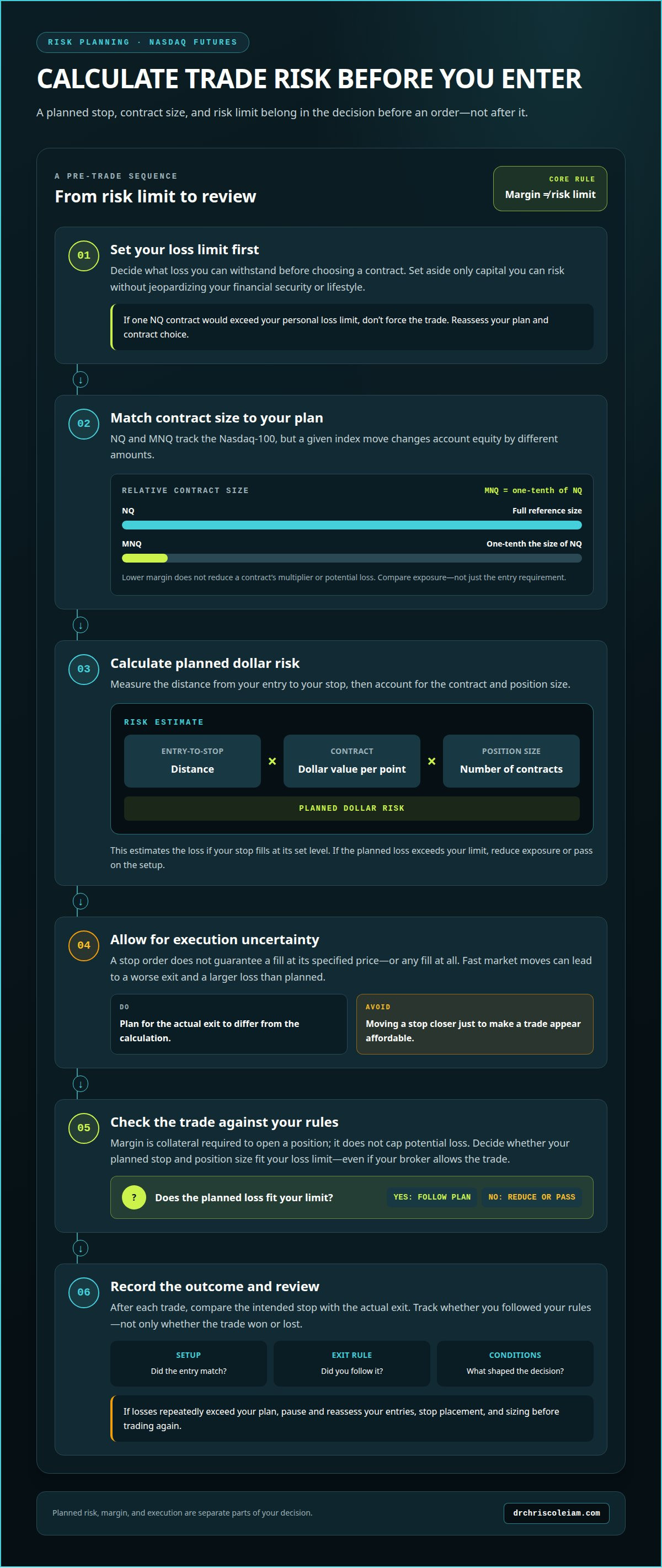
Calculate planned dollar risk before opening a position. Multiply the distance from entry to stop by the contract’s dollar value per point, then by the number of contracts. This estimates the loss if your stop fills at its set level. A practical approach to how to trade NQ futures with a small account starts with this calculation, not the margin shown in your account.
Set your risk tolerance first. If the planned loss exceeds your limit, reduce exposure or pass on the setup. Don’t move a stop closer just to make a trade appear affordable.
Plan for execution to differ from your calculation. A stop order doesn’t guarantee a fill at its specified price, or any fill at all. Fast market moves can lead to a worse exit and larger losses than planned. Record the intended stop and actual exit after each trade, then compare them.
Keep margin and trade risk separate. Initial margin is collateral required to open a position; it doesn’t cap your potential loss. When deciding how to trade NQ futures with a small account, assess whether your planned stop and position size fit your loss limit, even if your broker allows the trade. Review results by setup and session. If losses repeatedly exceed your plan, pause and reassess your entries, stop placement, and sizing before trading again.
For comparison, a 10-point distance between entry and stop corresponds to a possible loss of about $50 per Micro E-mini S&P 500 contract.
Dr. Chris Cole IAM: The 4 Hr Trade Room Skool Community
Dr. Chris Cole IAM offers the 4 Hr Trade Room Community as a next step if you want structured trading education and community-based learning. It can complement your own market analysis as you build a plan, define risk, and review how consistently you follow it. Education and tools support your process; they don’t remove market risk or make trading decisions for you.
Choose resources that match the specific gap in your routine. If you need a reference for Nasdaq futures, Daily Auric Levels for Gold, Nasdaq and S&P 500 Futures include levels for those markets. If you want chart tools, Dr. Cole’s TradingView Algos are another listed offering. Use any tool alongside your own entry, stop, and position-size rules, not as a substitute for them.
- Daily Auric Levels: Use the Nasdaq levels as a reference point in your planned market analysis.
- Auric Options Levels: These levels cover GLD, QQQ, and SPY options if those markets are part of your study.
- Dr. Cole’s TradingView Algos: Consider these chart tools as part of a defined review process.
The 4 Hr Trade Room Community may suit you when you want a learning environment alongside independent practice. Bring a clear question from your trade review, such as whether your entry followed your plan or your stop matched your intended risk. Keep the decision-making yours, record the outcome, and use education to sharpen your process over time.
If you’d like to discuss whether the community or its trading tools fit your learning goals, contact Dr. Chris Cole IAM.
Frequently Asked Questions
What is a futures contract?
A futures contract is an agreement to buy or sell an asset at a set price for settlement on a future date. NQ futures track the Nasdaq-100 Index, so your gain or loss changes with the index and your position. Before trading, identify the contract month, expiration, and exit plan. Futures can create substantial losses, so understand the contract before placing an order.
What Are Micro Futures?
Micro futures are smaller-sized futures contracts tied to the same market as a larger contract. MNQ tracks the Nasdaq-100, like NQ, but its multiplier is one-tenth the size. That smaller contract size lets you adjust exposure in smaller increments. For example, a trader can use MNQ to test a defined setup with less dollar exposure than one NQ contract.
What is futures margin?
Futures margin is money held in your account to support an open position. It is not the contract’s full value and does not cap possible losses. Your broker sets the margin requirement for your account, and exchange requirements may also affect it. Keep enough equity to account for price movement, and understand your broker’s liquidation and margin-call procedures before trading.
What are the CME contract specifications for E-mini Nasdaq-100 (NQ) futures?
Its minimum tick is 0.25 index points, worth $5.00 per contract. NQ futures are cash-settled and expire quarterly in March, June, September, and December. These specifications help you translate an index move into dollars and identify the contract month you’re trading.
What are the CME contract specifications for Micro E-mini Nasdaq-100 (MNQ) futures?
Use the multiplier and tick value to calculate exposure before entering a position.
How much margin do brokers require to day trade NQ and MNQ futures?
Broker day-trading margins vary. These figures are not universal exchange requirements, and brokers can set different terms. Margin may also change with market conditions or position-holding rules. Confirm the requirement that applies to your account and plan for losses beyond the margin deposit.