Trading Micro Nasdaq MNQ vs E-mini NQ: Compare Exposure
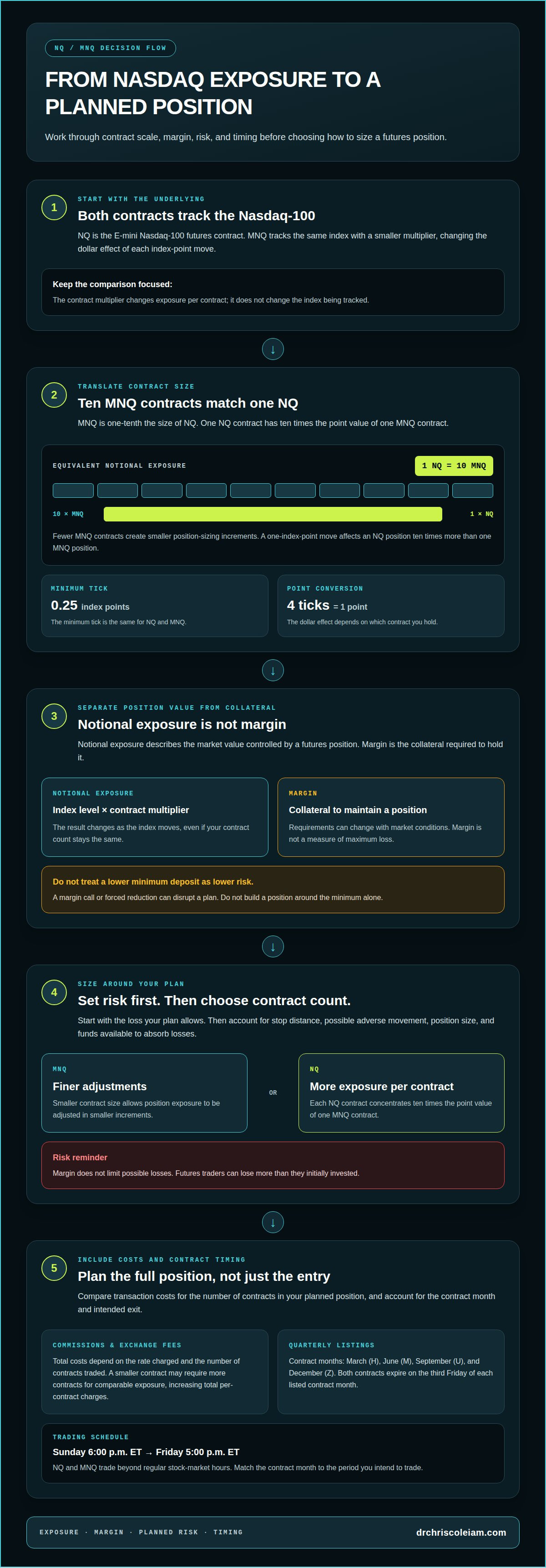
Ten MNQ contracts have the same notional exposure as one NQ contract.
When comparing the contracts, size is only part of the decision. Position sizing, changing margin requirements, and the risk you can plan for matter too. MNQ lets you adjust exposure in smaller increments, while each NQ contract has ten times the point value.
This comparison explains how contract size affects notional exposure and potential gains or losses per index-point move, why margin is not a fixed measure of risk, and how to decide which contract may fit your trading plan and account discipline.
Key Takeaways
- MNQ and NQ track the same Nasdaq 100 market, but MNQ’s contract multiplier is one-tenth the size of NQ’s.
- Compare notional exposure with margin separately; margin requirements can change with market conditions.
- Use contract size to align position scaling with your planned risk, rather than treating lower margin as lower risk.
- Daily Auric Levels for Nasdaq futures can add market context to your preparation and trade review.
What is the E-mini Nasdaq 100 futures contract?
The E-mini Nasdaq-100 futures contract, ticker NQ, tracks the Nasdaq-100 Index through a standardized futures contract. MNQ tracks the same index, with a smaller multiplier that changes the dollar effect of each point.
Contract Multipliers and Tick Values
A multiplier sets the dollar value of each Nasdaq-100 Index point for one contract. That difference gives you a clear way to compare exposure before choosing a contract. A one-point move affects an NQ position ten times more than one MNQ position.
Contract Size and Tick Size
Contract size describes how much index exposure each futures contract represents, while tick size is the smallest listed price movement. For both NQ and MNQ, the minimum tick is 0.25 index points. This distinction matters when planning entries and exits. A four-tick move equals one index point, with different dollar effects for each contract.
Relative Size and Notional Exposure
MNQ is one-tenth the size of NQ, so ten MNQ contracts represent the same notional exposure as one NQ contract. Both follow the 100-stock Nasdaq-100 Index, but the multiplier determines the exposure attached to each contract. Use that calculation to understand the position’s scale; it is not the margin required to open it. Russell futures track a different index, so they are not substitutes for Nasdaq-100 exposure.
Trading Hours and Contract Months
NQ and MNQ trade from Sunday at 6:00 p.m. ET to Friday at 5:00 p.m. ET, giving you access beyond regular stock-market hours. NQ futures are listed quarterly for March (H), June (M), September (U), and December (Z). Both contracts expire on the third Friday of each listed contract month. These schedules matter when you plan a strategy across sessions or manage a position near expiration. Match the contract month to the market period you intend to trade.
Micro E-mini futures compared with E-mini futures
MNQ and NQ track the same benchmark, but each contract has a different dollar impact. Consider exposure, available capital, transaction costs, and the risk you can plan for when choosing between them.
Dollar Impact of Price Moves
The multiplier determines how much a Nasdaq futures price move changes your position’s value. That difference matters when setting a stop or calculating a planned loss. Size the trade according to the amount you can risk, not the margin shown to open it.
Capital Requirements
Futures provide notional exposure through margin, but margin does not limit possible losses. These entry-margin examples do not establish how much capital you need to trade responsibly. Your risk plan should also account for stop distance, potential adverse movement, and funds available to absorb losses. Futures traders can lose more than they initially invested.
There is no single capital amount that makes MNQ or NQ suitable for every trader. The amount you need depends on planned loss per trade, position size, and ability to withstand adverse moves. Margin alone cannot answer that question.
Commissions and Exchange Fees
Commissions and exchange fees are transaction costs. The total depends on the rate charged and the number of contracts traded, so there is no universal MNQ-versus-NQ fee that applies to every account. Compare the full cost of your planned position, including how many contracts you need for your target exposure. A smaller contract may require more contracts to reach a comparable position size, increasing total per-contract charges.
Build expiration into your plan, too. NQ and MNQ have quarterly listings for March, June, September, and December, with expiration on the third Friday of each listed contract month. Before holding a position through a contract change, account for the listed month and your intended exit. Disciplined futures trading means planning exposure, costs, and timing together, not treating a lower margin figure as lower risk.
NQ and MNQ notional exposure and margin
Notional exposure measures the market value controlled by a futures position; margin is the deposit required to hold it. Keep these figures distinct when comparing contract size with your available trading capital.
Notional Exposure Across Contracts
For either contract, notional exposure is calculated by multiplying the Nasdaq-100 Index level by the contract multiplier. The result changes as the index moves, even if your contract count stays constant. Ten MNQ contracts match one NQ contract’s notional exposure, while fewer MNQ contracts create smaller increments for position sizing. This distinction helps you relate the position to your account, rather than treating the margin deposit as the position’s full market value.
Notional exposure describes the scale of a position, not how much you will lose. Your actual gain or loss depends on index movement and the number of contracts held. Include both contract count and planned exit in your risk calculations. A liquid market does not eliminate the risk of adverse price changes.
Micro and E-mini Margin Requirements
Margin is collateral required to maintain a futures position, not the same as notional value. These figures describe different margin settings, so don’t treat them as interchangeable or as a measure of maximum loss.
Futures margin requirements can change with market conditions. A lower minimum deposit for a micro contract does not make the underlying exposure risk-free or define responsible account capital. Allow for adverse movement in your plan, and size each position according to the loss you have chosen to accept. If prices move against them, futures traders can lose more than they initially invested.
Before opening a position, distinguish its notional exposure from the margin required. Then assess whether your available capital can support your planned position and risk limits. A margin call or forced reduction can disrupt your plan, so don’t build a position around the minimum alone.
E-mini vs Micro: Which Should You Trade?
Choose contract size based on your planned risk, account equity, and position strategy. MNQ allows finer adjustments; NQ concentrates more exposure in each contract.
Position Sizing and Risk Management
Position sizing determines how many contracts you trade within a defined risk plan. Start with the loss your plan allows, then account for the distance between entry and exit. This helps you compare potential exposure before placing an order, but a stop cannot guarantee an exact exit price.
Keep margin separate from risk. The amount required to hold a position does not set your maximum loss. Account for market movement and available equity before sizing either contract.
Flexibility in Position Sizing
MNQ’s smaller contract size lets you adjust exposure in finer increments. Since MNQ is one-tenth the size of NQ, you can add or reduce part of your exposure without immediately changing a full NQ contract. This flexibility can help align position size with a specific risk limit or an evolving trade plan.
For example, a trader can use MNQ to make smaller adjustments as a setup develops, then reassess total exposure. Trading more contracts also means managing more individual positions, so include the total exposure in your risk calculation.
Choosing Between NQ and MNQ Sizes
Choose MNQ if smaller increments better fit your planned risk; consider NQ when its larger contract size fits your position plan. Traders with smaller accounts often start with Micro contracts and may scale into standard contracts as account size and confidence grow. MNQ is recommended for accounts of $5,000-$15,000 in the market guidance, but that range does not replace individual risk planning.
Build the decision around your rules, not a desire to trade the largest position. If you want structured support for Nasdaq futures preparation, explore futures trading education as part of your process.
Dr. Chris Cole IAM: Daily Auric Levels for Gold, Nasdaq and S&P 500 Futures
Dr. Chris Cole IAM provides Daily Auric Levels for Gold, Nasdaq and S&P 500 Futures, giving you market levels to consider alongside your MNQ or NQ plan. Use them as part of preparation and market analysis, not as a substitute for choosing position size, defining risk, or following your rules.
These levels can provide a structured reference for Nasdaq futures before a session or during trade review. Pair that context with your contract choice: MNQ and NQ have different dollar impacts, so your position still needs to fit your planned risk. Dr. Cole’s TradingView Algos and Auric Trading Assistant are also tools for your trading process.
To learn more about these trading tools and levels, contact Dr. Chris Cole IAM.
Make Your Next Trade Plan More Deliberate
Before your next Nasdaq futures session, write down the conditions that would lead you to enter, reduce, or exit a position. Review whether your chosen contract still fits that plan as market conditions change. Deciding whether to trade Micro Nasdaq MNQ or E-mini NQ is only one part of disciplined execution; preparation and reflection shape how you act on that decision.
Dr. Chris Cole IAM offers Futures and Options Trading Education and Auric Options Levels for GLD, QQQ, and SPY for traders seeking structured learning and market context. Use these resources to support your process, while keeping responsibility for each trading decision in your own hands.
Take the next step in your trading education and contact Dr. Chris Cole IAM. Keep learning, keep reviewing, and grow as a trader.
Frequently Asked Questions
Why do active traders use NQ futures?
Active traders use NQ futures to take positions tied to the Nasdaq-100 through a single contract. The futures market also trades beyond regular U.S. stock-market hours, allowing traders to respond to market-moving events outside the cash session. Before choosing NQ, consider whether its larger dollar exposure fits your plan, including how you’ll manage entries, exits, and unexpected price movement.
Can newer traders start with MNQ?
Yes, newer traders can start with MNQ if they understand futures risk and follow a defined plan. Its smaller exposure per contract can make it easier to practice setting entries, exits, and position limits with finer size adjustments. If you’re trading Micro Nasdaq MNQ vs. E-mini NQ, first learn how each tick affects your position, then review whether your execution follows your rules. Smaller size does not remove the risk of loss.
How do NQ and MNQ futures work?
NQ and MNQ are futures contracts tied to the Nasdaq-100 Index. You can take a position based on whether you expect the index to rise or fall, then gains or losses change as the futures price moves. These contracts are financially settled, so the position is settled financially rather than through delivery of the index’s stocks. Your result depends on price movement and position size.
What are the benefits of trading NQ futures?
NQ futures provide exposure to Nasdaq-100 price movement through one standardized contract, rather than requiring separate positions in individual companies. Their extended trading schedule can also let you respond to events outside regular stock hours. These features may suit a strategy built around index movement and active monitoring. The larger contract size demands deliberate risk planning; access and exposure alone don’t make a trade suitable.
What are the risks of trading NQ futures?
NQ futures carry substantial risk because even a relatively small index move can significantly change your position’s value. Margin does not cap that loss, and traders can lose more than they initially invested if a trade moves against them. Market gaps, rapid price changes, and execution decisions can all affect outcomes. Set risk limits before entering, and don’t size a trade by margin alone.
What is the difference between NQ and MNQ futures?
The main difference is contract size: MNQ represents one-tenth the exposure of NQ. That makes MNQ suitable for adjusting exposure in smaller increments, while each NQ contract carries greater dollar impact for the same index movement. For trading Micro Nasdaq MNQ vs. E-mini NQ, base your choice on planned position size, risk limits, and your ability to manage price changes. Both track the Nasdaq-100 and share the same listed contract months.